Find private details
Combine pattern-based rules and contextual checks with a local BERT-small INT8 model. Rules cover credentials, IDs, bank accounts, phone numbers, and Indonesian formats such as NIK and Rupiah amounts.
Privacy engineering · AI & documents / 2026
A browser extension that reviews AI chats and documents, redacts sensitive details and the numbers that reveal them, then shares an encrypted, crawler-resistant copy.
Built around local detection, arithmetic inference checks, client-side AES-256-GCM encryption, and a relay that stores ciphertext. Supports ChatGPT, Claude, Gemini, DeepSeek, Word Online, and Google Docs.
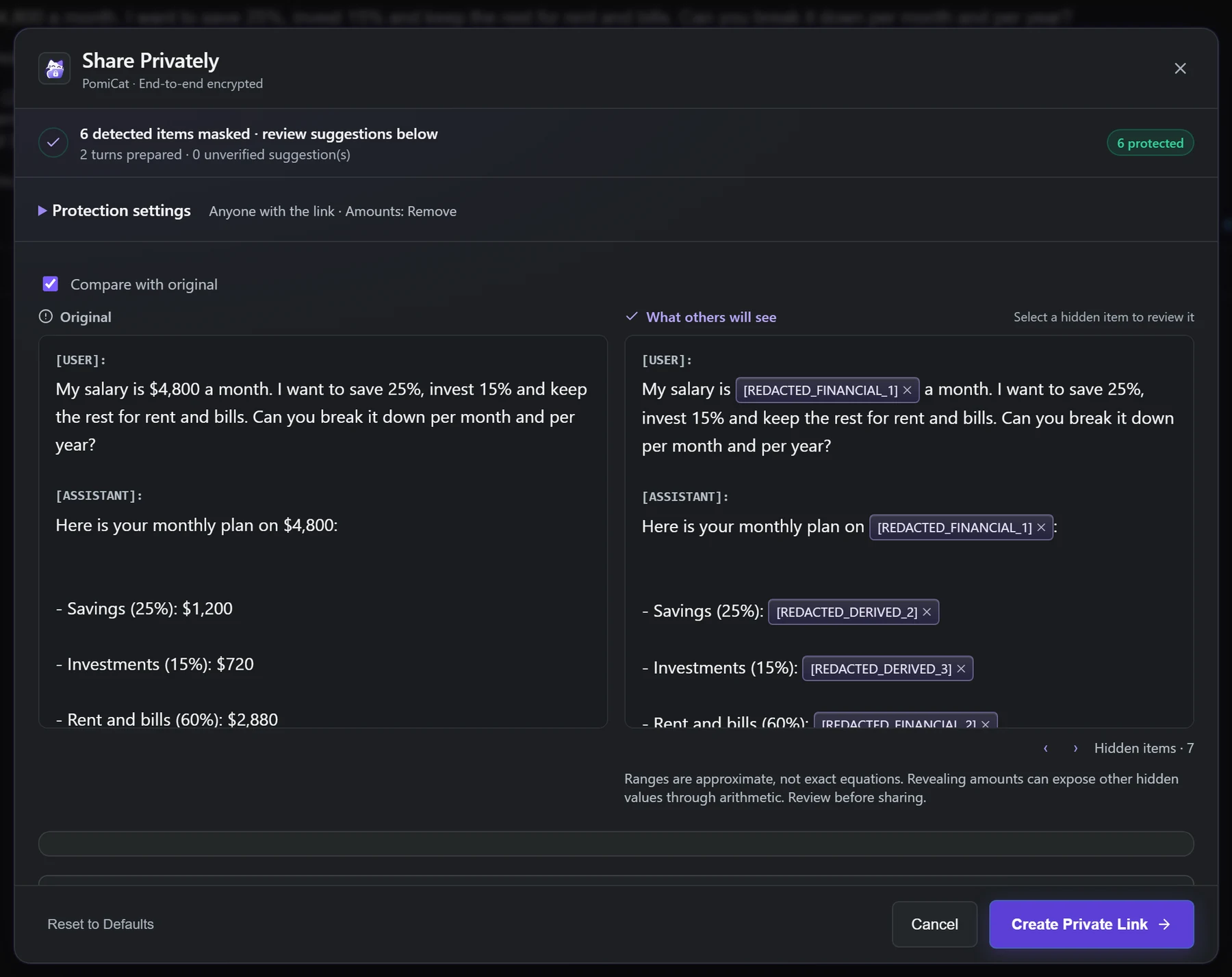
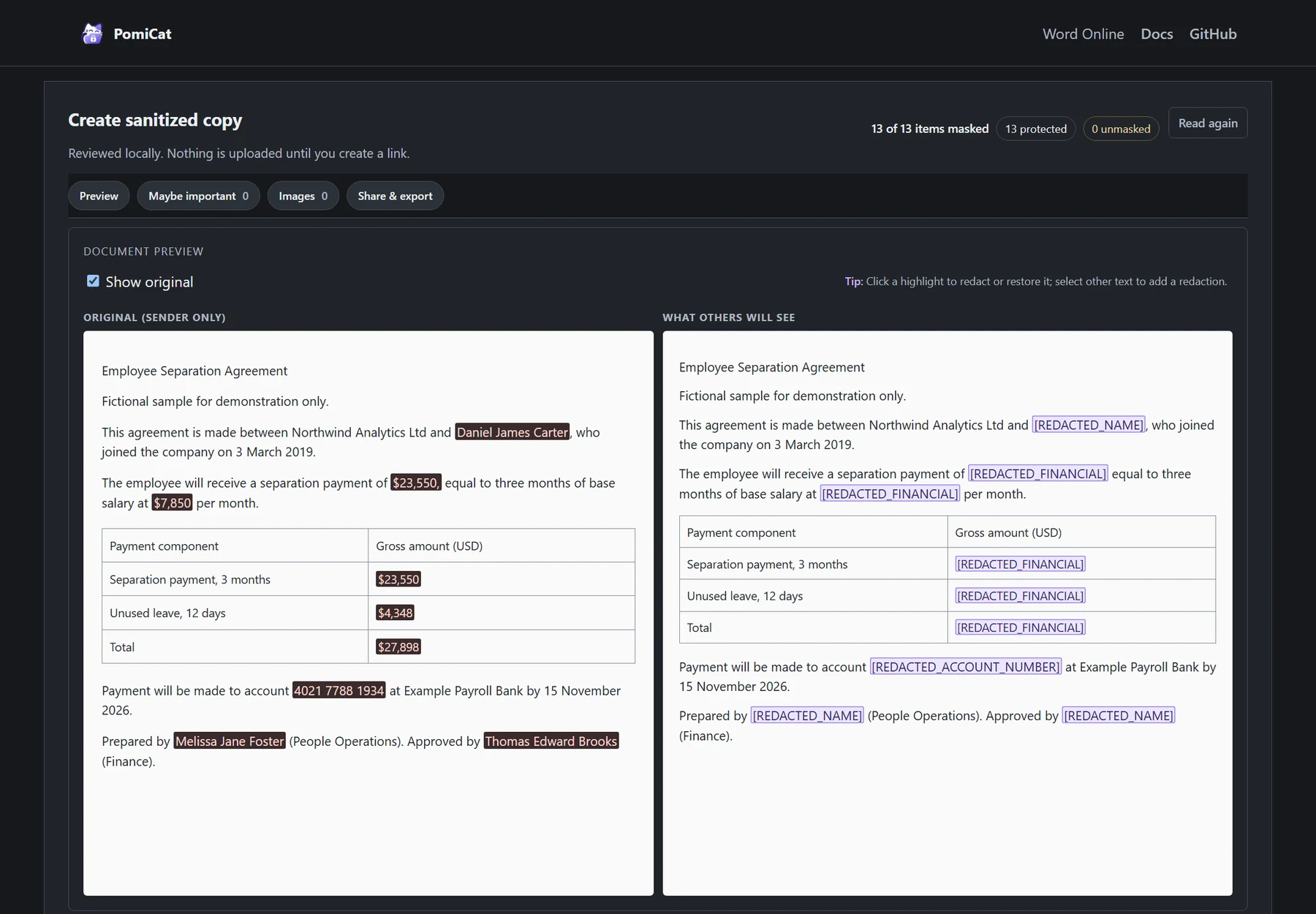
Shared AI chats have appeared in search results, and a share link is an ordinary web page. Hiding one value is not enough: salaries, dates, and other details can be reconstructed from the numbers around them. Documents carry the same risk.
Combine pattern-based rules and contextual checks with a local BERT-small INT8 model. Rules cover credentials, IDs, bank accounts, phone numbers, and Indonesian formats such as NIK and Rupiah amounts.
Look for ratios, monthly and yearly versions, projections, sums, and differences that reveal a hidden amount across messages. Run the same attack against the reviewed copy before sharing.
Review a separate DOCX copy from Word Online or Google Docs. Remove tracked changes, comments, and document properties; image pixels are marked manually, and the original document is not changed.
Encrypt the reviewed copy in the browser with AES-256-GCM. The key stays after the URL fragment, the relay stores ciphertext, and links support expiry, burn-after-reading, and revocation with a noindex response.
PomiCat 3.0.2 is available as Chrome and Firefox builds through GitHub releases, with an Apache-2.0 codebase and a docs site. In the documented evaluation — 40 fictional chats, four runs, three LLMs — no hidden salary was recovered after PomiCat redaction (0 of 160), compared with 100% after naive redaction. Googlebot tests check that chat and document links return ciphertext and no key.
The local model is English-focused; other languages rely mostly on rules. Unsupported arithmetic, combinations of details, text in images, and attachments remain out of scope. Links are bearer links: anyone with the full link can read and save the copy. The relay sees IP addresses, timing, and sizes; the hosted fallback viewer must be trusted. Screenshots cannot be prevented. Detection is best-effort; review the copy before sharing.
Why redacting the salary still leaves it recoverable, what three LLMs did with 40 fictional chats, and why the link key stays after the #.
Read the post (opens in new tab)Ongoing work focuses on detection coverage, document workflows, and release hardening.
Want to discuss this project?
Email me